

Understanding how to calculate intrinsic value of the stock is one of the most important skills for any investor. Intrinsic value tells you the real worth of a company, regardless of its current market price. When you know a stock’s true value, you can avoid overpaying, identify undervalued opportunities, and make smarter long-term decisions.
In India, many beginners rely on tips or social media trends, but experienced investors use valuation techniques to find whether a stock is cheap, fairly priced, or overpriced. In this guide, you’ll learn everything about intrinsic value in simple, conversational English with examples.
What Is Intrinsic Value?
Intrinsic value is the actual, fair, or true worth of a company based on its financial performance, future potential, assets, and earnings.
Market price = What people are willing to pay
Intrinsic value = What the stock is really worth
Example:
A stock is trading at ₹400, but after analysis, you find its intrinsic value is ₹550.
This means the stock is undervalued and can be a good opportunity.
When someone asks how to calculate true value of a stock, they are essentially talking about intrinsic value.
How Intrinsic Value Works?
The stock market price changes daily due to news, emotions, hype, fear, and demand-supply.
Intrinsic value stays stable because it depends on:
-
Company earnings
-
Cash flows
-
Growth rate
-
Assets
-
Debt
-
Competitive strength
Smart investors compare intrinsic value with current price:
-
If market price < intrinsic value → Buy (undervalued)
-
If market price > intrinsic value → Avoid or sell (overvalued)
This concept is used by legendary investors like Warren Buffett to find high-quality businesses.
If you ever wondered how to find intrinsic value of a stock reliably, it always starts with understanding financials rather than market emotions.
Step-by-Step Guide: How to Calculate Intrinsic Value of the Stock?
There are multiple ways to calculate intrinsic value. Let’s go through the most beginner-friendly and practical methods.
Step 1: Understand Key Financial Metrics
Before calculating intrinsic value, you must understand these terms:
-
EPS (Earnings Per Share)
-
Free Cash Flow (FCF)
-
Growth rate
-
Discount rate
-
Book value
-
Net profit
-
Revenue
-
Debt levels
These values are available on websites like Screener.in, Moneycontrol, and TickerTape.
When someone asks how to calculate intrinsic value of a stock in India, this is where you begin: the company’s financial statements.
Step 2: Choose a Valuation Method
There are 4 main methods investors use.
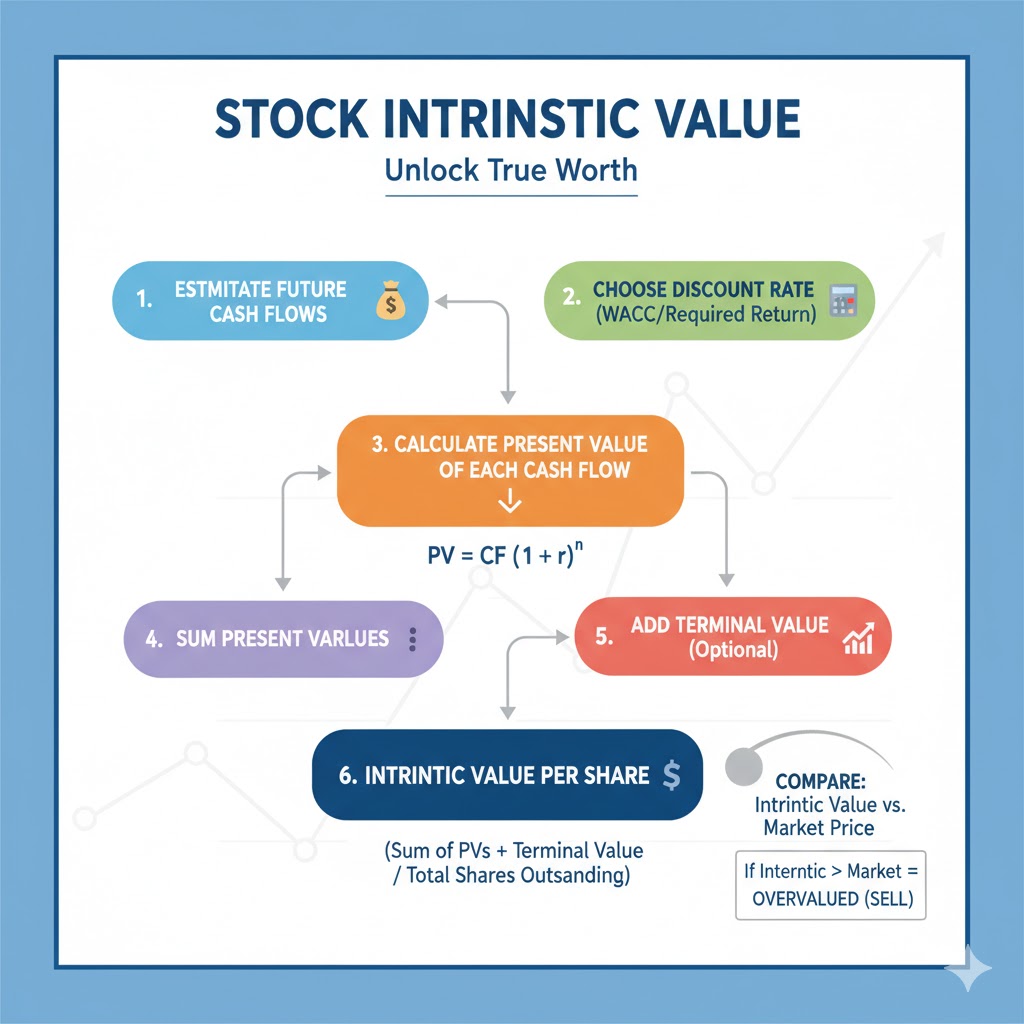
Method 1: Discounted Cash Flow (DCF) Method
DCF is the most accurate way to calculate intrinsic value.
It estimates the value of a stock based on expected future cash flows.
Steps:
-
Find last year’s Free Cash Flow (FCF).
-
Estimate FCF growth rate for the next 5–10 years.
-
Select a discount rate (usually 10–12% in India).
-
Calculate Terminal Value.
-
Discount all future cash flows to present value.
-
Divide by the number of shares.
Example:
A company has FCF of ₹500 crore and grows at 10%. After DCF calculation, you find the intrinsic value is ₹1,000 per share while the market price is ₹750.
That means the stock is undervalued.
This is the most reliable method for those learning how to calculate intrinsic value of a share accurately.
Method 2: EPS Valuation Method
This method is simpler and commonly used by beginners.
Formula:
Intrinsic Value = EPS × (1 + Growth Rate) × PE Ratio Estimate
Example:
EPS = ₹20
Growth = 10%
PE Estimate = 20
Intrinsic Value = 20 × 1.10 × 20 = ₹440
This is useful when learning how to calculate intrinsic value of a stock quickly without complex formulas.
Method 3: Graham Formula
Created by Benjamin Graham (Warren Buffett’s mentor).
Good for stable companies.
Formula:
Intrinsic Value = EPS × (8.5 + 2 × Growth Rate)
If EPS = ₹15 and growth = 8%:
Value = 15 × (8.5 + 16) = ₹367.5
This works well when you want a simple and reliable method.
Method 4: Book Value Method
Book value is the company’s total assets minus liabilities.
Useful for banks, NBFCs, and asset-heavy sectors.
Intrinsic Value ≈ Book Value per share (if the business is stable)
How to Calculate Intrinsic Value of a Stock Option?
For options, intrinsic value is:
For Call Option:
Intrinsic Value = Market Price – Strike Price
For Put Option:
Intrinsic Value = Strike Price – Market Price
If a stock trades at ₹900 and call option strike is ₹850 → Intrinsic value = ₹50.
That’s how to calculate intrinsic value of a stock option in the simplest way.
Special Case: Stocks with Negative EPS
Sometimes companies report losses (negative EPS).
Many beginners wonder how to calculate intrinsic value of a stock with negative EPS.
Using EPS-based formulas will not work.
Instead, use:
-
DCF method
-
Book value method
-
Asset valuation
-
Industry comparisons
Loss-making companies require extra caution because valuation becomes unpredictable.
Practical Examples of Intrinsic Value Calculation
Example 1: DCF Example (Simple Version)
Free Cash Flow: ₹100 crore
Growth for 5 years: 10%
Discount rate: 12%
Calculate future cash flows → discount to present → subtract debt → divide by outstanding shares.
If the final value is ₹650 per share and the stock trades at ₹500, it’s undervalued.
Example 2: EPS Valuation Example
EPS: ₹10
Growth: 12%
Estimated PE: 18
Intrinsic Value = 10 × 1.12 × 18 = ₹201.6
Example 3: Option Example
Market price: ₹1200
Call strike: ₹1100
Intrinsic Value = 1200 – 1100 = ₹100
Benefits of Knowing Intrinsic Value
-
Helps avoid overvalued stocks
-
Makes buying decisions logical
-
Reduces risk of losses
-
Encourages long-term investing
-
Identifies undervalued opportunities
-
Improves financial understanding
-
Protects from hype-driven decisions
Intrinsic value is your safety shield in the stock market.
Risks and Mistakes to Avoid
-
Using unrealistic growth rates
-
Using incorrect discount rate
-
Blindly trusting online tools
-
Not understanding business fundamentals
-
Ignoring debt
-
Using one method only (always compare 2–3 methods)
-
Not updating intrinsic value regularly
Calculations are only as good as the assumptions you use.
Best Tips for Calculating Intrinsic Value Correctly
-
Use conservative assumptions
-
Prefer companies with stable cash flows
-
Ignore short-term volatility
-
Compare results from multiple models
-
Recalculate after quarterly results
-
Study annual reports
-
Avoid companies with unpredictable earnings
These tips help you value companies with more confidence.
Comparison Table of Intrinsic Value Methods
| Method | Difficulty | Accuracy | Best Use Case |
|---|---|---|---|
| DCF | Hard | Very High | Predictable cash flow companies |
| EPS Valuation | Easy | Medium | Beginner analysis |
| Graham Formula | Easy | Medium | Stable companies |
| Book Value | Easy | Low-Medium | Banks & asset-based stocks |
| Option Intrinsic Value | Easy | High | Options traders |
Conclusion
Learning how to calculate intrinsic value of the stock is one of the most valuable skills for long-term investing. Whether you use DCF, EPS valuation, the Graham formula, or book value method, intrinsic value helps you identify if a stock is undervalued or overpriced. By comparing intrinsic value with the current market price, you make smart, informed, and profitable decisions. Keep practicing with real companies, use conservative estimates, and invest only in businesses you understand. Your goal is not to predict the market—but to calculate real value and invest wisely.
FAQs: How to Calculate Intrinsic Value of the Stock
1. What is the easiest way to learn how to calculate intrinsic value of the stock?
Start with EPS valuation or the Graham formula.
2. How to calculate intrinsic value of a share quickly?
Intrinsic Value = EPS × (1 + growth rate) × PE estimate.
3. How to find intrinsic value of a stock for long-term investment?
Use the DCF method as it’s the most accurate.
4. How to calculate true value of a stock without complex formulas?
Use Graham formula or book value valuation.
5. How to calculate intrinsic value of a stock in India using apps?
Apps like Tickertape, Screener, and Moneycontrol provide basic valuation tools.
6. How to calculate intrinsic value of a stock option easily?
For calls: Market price – Strike price.
For puts: Strike price – Market price.
7. How to calculate intrinsic value of a stock with negative EPS?
Use DCF or book value; EPS methods won’t work.
8. Is intrinsic value always accurate?
No, it depends on your assumptions, growth estimates, and financial knowledge.
9. Do I need to calculate intrinsic value for every stock?
Only for long-term investments. Traders don’t need it.
10. Why do analysts have different intrinsic values for the same company?
They use different assumptions for growth, discount rate, and cash flows.